If you have a problem, fix it. But train yourself not to worry, worry fixes nothing. - Ernest Hemingway
Showing posts with label Women. Show all posts

Monday, 12 August 2024

How they beat Vinesh Phogat—The (almost) complete story


Since 7 August, I have been sad and angry about what has happened to a young woman who I haven’t met and will never meet: Vinesh Phogat, who was disqualified before the finals of the Paris Olympics freestyle wrestling in the 50 Kg category. Because  she was overweight by 100 grams.

Her disqualification hurts even more because the day before—when her weight hadn’t been an issue—Vinesh made history by reaching Olympics wrestling finals, the first Indian woman to achieve the feat. In a day, she defeated the following wrestlers (scores in bracket):

Yui Susaki, the defending Olympic champion from Japan (3-2),

Oksana Livach of Ukraine, the European champion (7-5), and

Cuba's Yusneylis Guzman, the Pan American Games champion (5-0).

So, Vinesh defeated the champions from three continents. But we will appreciate her feat better if we look at Susaki’s accomplishments. Susaki won gold in the 2020 Olympics WITHOUT LOSING  A POINT; she has been a world champion FOUR times. Wikipedia says: Susaki lost her first-round bout against Indian wrestler Vinesh Phogat, which was her first loss in 95 matches” in international competitions. So, what Vinesh did was like defeating Rod Lever in Tennis, who had won the last two Grand Slams he participated in, or beating the Italian boxer Rocky Marciano, the only undefeated heavyweight boxer in history who had won 47 successive bouts!

Do we now realise enormity of what Vinesh achieved? And yet, just a day later, she would be disgraced and banished to the bottom of the merit list for absolutely no fault of hers!

Let us see what the chief physician accompanying Indian athletes says on the fiasco. Indian Express (8 August) says:

QUOTE Dr Dinshaw Pardiwala, the Chief Medical Officer of the Indian contingent [at Paris], said that following her three bouts on Tuesday, Phogat had to be given some water “to avoid dehydration”. … “We found that her post-participation weight increased more than normal and the coach initiated the normal process of weight cut that he has always employed with Vinesh,” Pardiwala said. “He felt confident it would be achieved.” UNQUOTE

The doctor’s statement is problematic because:

(A) “To avoid dehydration,” what is given is oral rehydration solution (ORS), not “water,” as stated by the doc.

(B) An athlete’s weight does not increase “post-participation,” it increases when she drinks ORS to replenish body fluids lost during a bout.

(C) The Chief Medical Officer seems to have passed the buck to Vinesh’s coach. One would like to know if in such a critical situation the doctor had any obligation to monitor the process of reduction of weight.

Hindustan Times reports* that her weight increased by 2.7 kgs instead of the normal 1.5 kgs. This additional increase couldn’t be brought down, although Vinesh and her team tried their best through the night by making her sweat through vigorous exercise, sauna, and even by cutting her hair.

In a situation like this, Vinesh’s ORS intake would have been carefully controlled. So the doctor’s statement her post-participation weight increased more than normal” is pure bullshit. The correct statement would be: SHE WAS GIVEN MORE ORS THAN WHAT WAS NORMAL. Her weight could not have increased by 2.7 kgs unless she ingested 2.7 kgs (+ the weight lost in bouts).

Was it a blunder by her support staff, an accident, or sabotage? We won’t know the answer, but the possibility of a mischief cannot be ruled out.

Mischief cannot be ruled out because what happened in Paris looks like the culmination of an asymmetric battle fought by a resolute Vinesh Phogat and her friends against a dirty power elite of India that rules over wrestling. Let me recall the story briefly.


THE BACKSTORY

A middle-aged BJP MP, Brijbhushan Sharan Singh was the president of the Indian Wrestling Federation of India (WFI) for ages. Seven female wrestlers, including a minor, alleged that he had been molesting them. The complainants included the leading lights in the sport, including Sakshi Malik (our only woman wrestling Olympic medal winner), Sangeeta Phogat, and Vinesh herself. In the normal course, Brijbhushan would have been arrested. In particular, the complaint of sexual harassment by a minor should have led to automatic arrest. Also, the government of India ought to have responded to the female  wrestlers’ repeated appeals and protected them.

But for BJP bigwigs, rules are different. The minor’s complaint was mysteriously withdrawn by her parents; for the other complaints, after much pushback  by the civil society and valiant protest by the wrestlers themselves (please see below), 2 FIRs were filed in June this year against the WFI president. Quite expectedly, nothing much is heard about the cases.

For the harassed wrestlers, getting justice is still a distant goal; even to get an FIR registered was a long and bitter struggle. As their complaints to the government including the prime minister yielded no result, the wrestlers began a dharna at Jantar Mantar, New Delhi in January 2023 demanding the dismissal sexual predator. They called off the agitation when the sports minister intervened and  promised to resolve their issues.

When the promise seemed hollow, the wrestlers resumed their protest in April. For a month, they ate and slept on the road and used public toilets. The government did nothing.

On the night of 28 May, the government finally took action. Delhi  Police assaulted our peaceful national heroes and Padmashrees brutally, and dragged them into waiting prison vans. In the process, Vinesh and two other wrestlers were injured.


Sadly, after all this BJP couldn’t give Brijbhushan a Lok Sabha ticket in this year’s general elections. So, they gave it to his son, who is an MP now. Also, Brijbhushan had been continuing as the head of WFI without holding election for years. When the WFI elections were ultimately held recently after severe criticism from the International Olympic Committee (IOC), Brijbhushan couldn’t become president.
He was replaced by his close friend, Sanjay Singh.

This is what the Indian government and the sports establishment did to protect our star athletes. BETI BACHAO, BETI PADHAO.

However, the WFI election was so murky that even the government was forced to ban WFI in January this year. But hold your breath! There are more twists in the tale.

When athletes around the world were preparing for the Olympics and following strict regimen of diet, exercise, mental conditioning, and practice, Vinesh and her friends were on the roads of Delhi at a sit-in strike that would be ended violently. Naturally, their preparations were seriously dislocated. Among the protesting wrestlers, none except Vinesh qualified. How she did is another sad story.

Vinesh, who was competing in the 53 Kg category for a long time, has a sterling record in that category, including Asian Championship and Commonwealth Games gold medals (2019, 2023), and two bronzes in World Championships (2021 and 23).

How she was pushed out of her comfort zone of 53 Kgs for the Paris Olympics can be the story of a pulp fiction. Another talented athlete, Amit Panghal was selected for the category as she had won a bronze in the previous World Wrestling Championship, held at a time when Vinesh had been injured. No problem there. But here comes the twist. Medal winners in international tournaments are not automatically selected for Olympics. They have to go through a domestic selection process once again. This stands to reason. After all, the nation would like to send the best athlete going by their present form. But for this year's Olympics, the WFI decided THERE WOULD BE NO TRIAL! Vinesh begged WFI for a trial, which was turned down. She even offered to fight Antim Panghal. (Incidentally, Panghal lost her only bout in Paris 0-10.) So, Vinesh Phogat was forced compete in the 50 Kg category, which was way outside her comfort zone. Many experts, including the veteran sports journalist Pradip Magazine, say that was the time when Vinesh Phogat was actually stabbed in the back.

Finally, for the 6 athletes in the wrestling squad in Paris, there are 12 wrestling officials, including the president of the banned federation, Sanjay Singh, who was in charge of the wrestlers there.

He had control over Vinesh Phogat and other wrestlers.

Tailpiece:

Our prime minister, who leaves his mark in everything newsworthy from Ram Temple to cheetahs, was completely silent during the ordeal suffered by wrestlers. Not a word did he say when they were beaten on the roads. But after Vinesh’s disqualification, he tweeted in English (a language she doesn’t speak), which had this unforgettable line: “Vinesh, … I wish words could express the sense of despair that I am experiencing.”

How charming!

11 August 2024

* [https://wwwDOThindustantimesDOTcom/sports/olympics/vinesh-phogats-nutritionist-expected-the-reason-behind-wrestlers-sudden-weight-increase-revealed-101723092671976.html]


Saturday, 8 January 2022

A postcard from the countryside: Homecoming

The tecoma, which had hardly any flowers when we left last month, is flowering, although the yellow bloom is yet to reach the fullness of spring. The same thing can be said about the pink bougainvillea. (Alas! I needed three attempts to get the spelling right!) The hibiscuses, which flower in all times, didn’t disappoint us either. The tiny beds of spinach and fenugreek too are doing well. And a few aubergines are ready to be plucked. On the whole, it was a happy homecoming: the spring is in the air.

The following day was perhaps the International Caterpillars' Day. In the morning, I saw more caterpillars together than what I had seen in the rest of my life. There were hundreds of them on the courtyard and on the roads near our house. Seemingly homeless, they were moving aimlessly in every direction. Was there a political strife in their habitation? Were they migrating? 

Our domestic help Gomathi Amma is exceedingly smart. Although we don’t have a common language, she understands everything we tell her and shapes out her ideas effectively in her limited Hindi and English vocabulary. She came as soon as she knew we had come. 

Gomathi Amma (who is some other Amma actually) is one of the countless women of our country who are treated harshly by life. Mother of a grown-up son and a daughter, she is a widow. But the passing of the abusive husband hasn’t given her freedom. Her father calls the shots in her life. Gomathi Amma supplements her income as a domestic help by tending her father’s 50 goats. She is naturally free-spirited. She is never absent, but comes to work anytime between 10 AM and 4 PM when she wishes. Her employer (my far better half) has accepted the arrangement because Gomathi Amma is great at work. 

Her son works in a factory and the daughter is married in Bengaluru to a man almost twice her age. The son doesn’t give Gomathi Amma any trouble, but the son-in-law does. The daughter is illtreated and beaten up. She wants to return home but cannot. Her mother is reconciled, but her grandfather won’t allow it. The old man, a factory worker and goat farmer, thinks it would be dishonourable for the family. (Indeed, there’s no dishonour in getting beaten by one’s own husband!) 

For Gomathi Amma, the new year didn’t begin on a happy note. Her son had an accident early in the morning of January 1. Karthik was going to a temple near Hosur with a friend. They were on a motorbike, with Karthik riding pillion. At four o’ clock when it was pitch dark, they crashed head-on with a bike from the other side at a sharp bend on the road. The biker on the other vehicle died on the spot. Karthik’s friend, who had a helmet but hadn’t strapped it up, was badly injured in the head. His helmet had flown some distance away upon the impact. Karthik, who had never had a helmet in life, had stitches on his face and a broken jaw. Gomathi Amma said Karthik had had “plastic surgery” and “clamps” have been fitted to fix his lower jaw. The words I have put within inverted commas, she said in English. For the jaw, she demonstrated it with her own. He cannot eat anything solid; it will take some time before he can. 

Gomathi Amma has already spent a lakh and thirty thousand on Kathik’s treatment. She borrowed most of it on interest, at 4% per month. (I have seen this everywhere, if the rate of interest is usurious, it is always given in months. The poor doesn’t think it is 48%.) But before leaving, she said, ‘I am not worried about my son. He will recover anyway. But I do not know what will happen to my daughter.’ 

I felt angry about Gomathi Amma’s son-in-law and son. Perhaps more about her son. How can he be so irresponsible that he doesn’t have a helmet although he has a bike? But later, on more tranquil reflection, the thought came to my mind: is Karthik really to blame? 

Or should we blame the complete lack of education that the country offers to her underprivileged, even in Tamil Nadu, the best managed state in India? Or, should we blame the state of the economy which has made motorbikes affordable but basic awareness impossible to achieve? What are our priorities, why are schools closed when shopping malls are open during the third wave of the pandemic?

08 January 2022

Monday, 10 May 2021

Smriti Pishi


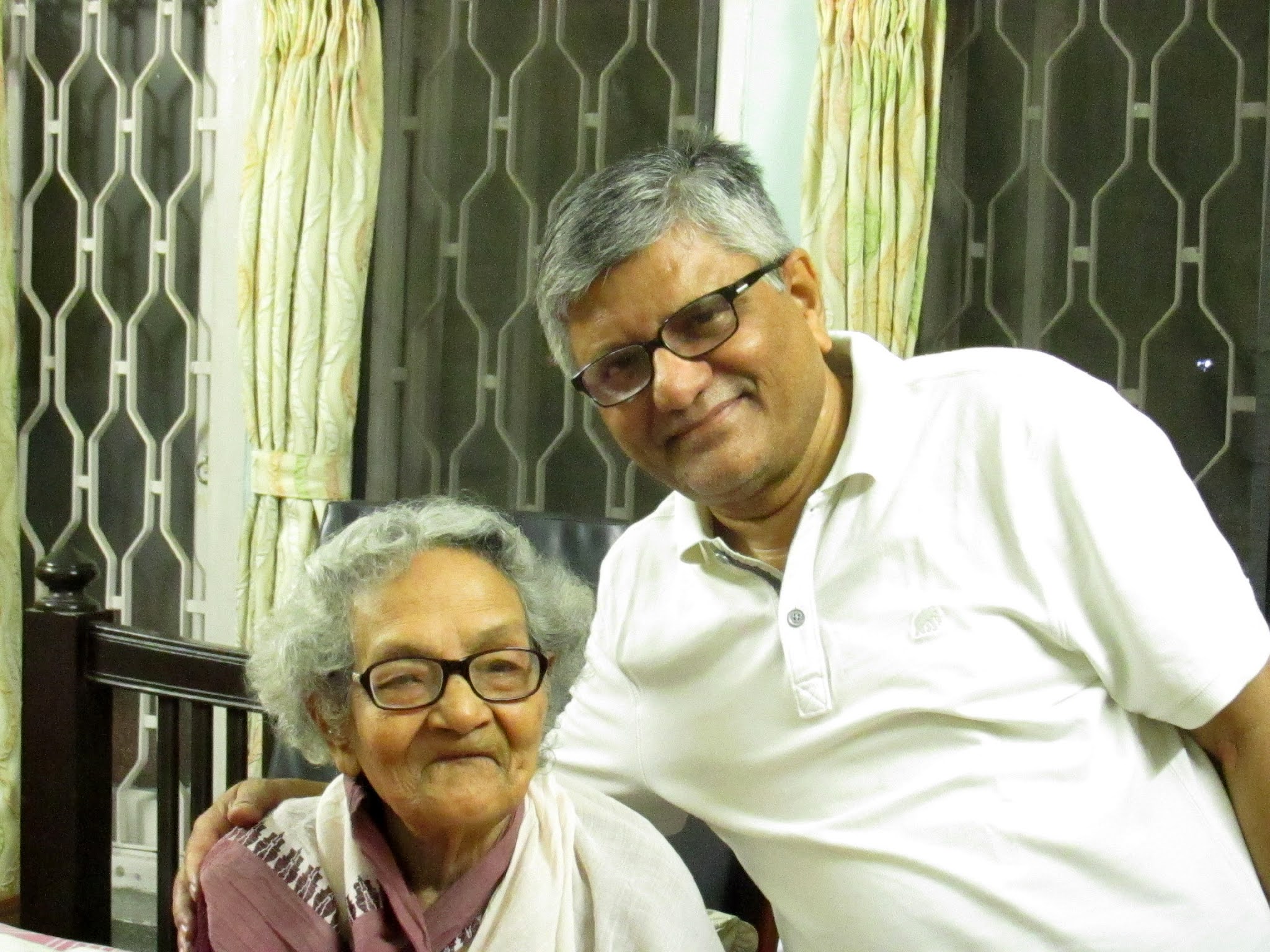
I was fortunate to be born in a family that had several strong, professionally successful, and exceptionally gritty women. Given the kind influence they had on me as a child, I was destined to be a respecter of women, if not a gynolator. One of those rock-solid feminine figures was Smriti Pishi, Dr. Mamata Chaudhuri.

Smriti Pishi, my father’s younger first cousin, was also a childhood friend of my mom in Karimgunj, a small town in Sylhet. If you look at the map of Eastern India, you will find Kolkata and Karimgunj on opposite sides across Bangladesh. Her father was a school teacher, a remarkable man who thought it fit to send his oldest daughter to study medicine in faraway Kolkata in the 1940s. Daughter didn’t fail him. She graduated, became a successful physician, married a brilliant doctor, and inspired her younger siblings. Rare would be a family in entire Bengal those days that produced three doctors and three engineers. Smriti Pishi had three other sisters who too were successful in different fields.

Dr. Mamata Chaudhuri specialised in paediatrics from the USA. As a child, I saw her driving her black Baby Austin (or was it a Morris Minor?) to hospital, where she also taught paediatrics. My sister and I were under her care as infants and so were my children. Smriti Pishi was a strong votary of breast feeding and detested commercial baby food. A schoolmaster’s daughter from a small town, the reality of an indigent India was at her heart. She would always tell my wife about the sources of nutrition for infants from everyday food that was equal if not better than tinned products. She was also a no-nonsense person. One day, my wife got an earful from her for putting kohl on our daughter's eyes. That day, the paediatrician began her prescription with: "No Kajal" (underlined).

My peripatetic job took me to different parts of the country, but I re-established contact with her as soon as I returned to Kolkata about 20 years ago. In her late 70s, she had left active medical practice then. Over the following 15 years, her mobility got restricted gradually, but her intellect was razor sharp. She read not only newspapers, but also serious tomes on a range of subjects. She and I shared a fondness for Amitav Ghosh. She was the one who told me about Madhusree Mukerjee’s pathbreaking book “Churchill’s Secret War”. After a visit to her home, I would come back with a sense that I had got to know something new. I believe her decline started when her eyes failed her and she couldn’t read beyond newspaper headlines. She was not much of a screen person, I believe. I never saw her watching TV.

Smriti Pishi was admitted to a hospital around the middle of April. The gritty woman that she was, she managed not to contract COVID-19 even after being in a hospital for two weeks. She was discharged by the end of April and breathed her last at home on 8 May at the age of 98.

In my dear pishi, I had a window to the past, the 1940s in particular: the life in a medical college then, the Bengal Famine, the grotesque Calcutta Killings of 1946, and my father as a young man who was her “friend, philosopher, and guide.” With her passing, the window has been shut for good. I will have to live with the many questions I didn’t ask her.

10 May 2021


Thursday, 24 September 2020

How are they now?


Ayana Sarkar, who has done Masters in Physics, is currently working for her PhD.

I loved reading this post by her. There’s something special about the empathy in her thoughts and in the simplicity of her style that makes me translate the passage into English. (Ayana , hope you will approve my translation? Maybe, you would have done a better job than me. Trust me, not kidding!)

*

The author is the third from left
Quite some time ago, I got an opportunity to visit a remote Adivasi village off Ghatshila, which is the second major station after Jamshedpur, about 50-60 kilometres away. From the Steel City, it takes 30 to 40 minutes to reach there. A tiny urban settlement in Jharkhand, lots of Bengalis live there.

As I walked out of the rail station with red concrete benches straight out of a storybook, I found a couple of eateries selling kachouris and jelabis, and a few small hotels.

I used to leave my bag in one of those and go out to discover the place. I would get off my auto-rikshaw at places hidden from me till then and have some snacks. Then, after exploring jungles, waterfalls, tracts of plain land, and the Subarnarekha, I would eat country-chicken curry, fried egg, and course rice in eateries wiped with cow dung, on the slope of a hill.

You can say it was my first experience of visiting what Americans call the boondocks. Since my childhood, I have lived in cities. As we don’t have any close relations in the country, I haven’t really visited rural areas. As soon as I came here, I knew this is what 80% of India is. Poor people living on the margins, they don’t get to eat two square meals every day. But even then, when strangers visit them, they would offer whatever food they can. They call you into their homes and love to talk with you. This is the first time I was with a farmer’s family, first time I saw a bullock cart. I watched with fascination people harvesting paddy. I had never seen all this before.

This is my India.

How is she today? Is she seething in anger? Can you do such injustice to the people who put food on your table?


[Postscript: I have read a few articles before and after our government changed the terms of agriculture in India lock-stock-and-barrel. None of those moved me as much as this one has. Thank you Ayana.]

Translated on 23 September 2020


Wednesday, 8 March 2017

Why Gurmehar Kaur cannot be tolerated


I bow to the brave teachers of the English Faculty of Lady Sriram College, New Delhi for standing up against vicious trolls, and stepping out for Gurmehar Kaur, one of their students who has presented a strong case against the combination of ultra-nationalism and vandalism we’re witnessing in India today.

So where do we stand? On one side are the ordinary people who don't believe that the present prime minister is the best thing that has happened to India since the glory days prehistoric aeronautical engineering / plastic surgery, those who believe the government is doing lots of terrible things, the primary among which are dividing the country on religious lines, increasing the gulf between the rich and the poor, and damaging our educational infrastructure.

On the other side, we have the thugs and vandals of the students' wing of the ruling party, semi-literate wrestlers and cricketers, and leaders, including ministers and MPs, who are just incapable of understanding the nuanced position Gurmehar has taken, whose boringly repetitive response to any criticism against them is: "YOU CANNOT SPEAK AGAINST THE NATION."

Oh dear! when did the ruling party and its goons become "the nation"? Then who are we? Who am I?

The physical attacks and filthy verbal abuses on the students and teachers of Delhi University don't seem to be a sporadic event. It seems part of a bigger agenda to limit the space for free thoughts. The strategy seems to be something like this: beat up protesters on the street (Ramjas College), harass / jail their leaders on fake charges (Kanhaiah Kumar), push inconvenient students to a corner from where they can never escape (Rohith Vemula), suspend, if possible, sack teacher who support free debates (Rajshree Ranawat of JNV University, Jodhpur), have an army of trolls who are led by some of the leading lights of the ruling party. Stop all forms of expression of dissent, hopefully, dissent itself will vanish from the minds of the people!

Why has the ruling party become so desperate?

For every autocratic political dispensation, the biggest threat is not the opposing political parties, it is not agitations on the streets, it is not the fear of losing elections, it is not even the possibility of a revolution.

It is the people’s ability to T H I N K!!!

Gurmehar Kaur, a girl all of 20 years, has the ability to put his father’s death in a war with Pakistan in a different perspective, she can say, “Pakistan didn’t kill my father, war did.”

Now, if a war hero’s daughter says that, it is difficult to sell the narrative of ultra-nationalism, the core of which is Pakistan bashing, which goes well with the agenda of whipping up passions against Indian Muslims.

So the ruling party has started a war to conquer the mind-space of the people. Whether they succeed or not depends on you, Dear Reader.

Bangalore / 1 March 2017


Thursday, 5 February 2015

A fairy tale of our time


Mita, who came to meet us this afternoon after a long time, has changed a lot. If I had met her on the street, I wouldn’t have recognized her; I would have taken her as just another smart young girl in her early twenties in a red salwar suit. But actually, Mita is very special, because her story is very special. But before I tell you her story, I must tell you a little about her family.

Mita was born into a caste that used to carry other people’s shit on their head. The “tradition” continued well into the twentieth century India parallel to steel plants, airplanes, and televisions. The practice has been abolished, but it hasn’t improved the lot of Mita’s people much. They continue to be “untouchables”. More often than not, “they” wouldn’t be invited to sit alongside “us” in a community dinner. In the country, they still live in filthy unhygienic ghettos on the outskirts of villages. The so-called upper-caste has no physical contact with them except when the village gentry rape their women.

In cities, they live in equally filthy unhygienic slums. Mita’s family lived in one such not far away from our home when her mother Lilavati joined our condo as a sweeper. They still live there and her mother still cleans bathrooms and drains, besides sweeping. Twenty years ago, Lilavati was a stunningly beautiful young woman. Now, after six children, recurring ailments, relentless overwork and poverty, she is an old woman in her mid-forties. But for the sake of completeness, I must add here that in all these years of trials and vicissitudes, Lilavati has held her head high. She has borrowed regularly and always repaid her debts in time. But she has never ever begged. 

Her husband was a drunkard. He worked occasionally and beat her regularly. Fortunately, his liver couldn’t manage the amount of alcohol he had been consuming and he had to leave a crying Lilavati and a huge debt behind when he was in the prime of his abused youth.

Of Lilavati’s two sons, one makes an honest living as – what else – a sweeper and the other is a professional thief. Neither supports their mother. Mita is the oldest daughter, and the other three, much smaller, are triplets.

Lilavati put her children in school and struggled to pay tuition fees and buy books. She wanted her girls to live a decent life. However, Mita left school and started working as a domestic help with a family in our building. And soon, she became an expert cook. So, early in her life, Mita made a smart career move and broke the shackles that had tied her forefathers for two thousand years!

When her father died, they needed a lot of cash to repay the debt they had run up for his treatment. Needless to say, most of the money had been borrowed at usurious rates and the debtors were on their back. So Mita made the second smart move in her life – around five years ago, she managed to find a domestic’s job in Mumbai, a city that pays working people a lot better.

Now she is a happily married young woman brimming with pride for her prince charming. A housewife now, she even pays for her younger sisters’ education. Presently her husband is away at Bangalore on work for a week. And Mita has flown down to Kolkata to be with her family. I do not know if she ever dreamed of boarding a flight when she was a child, but it is a reality today and no wonder: her husband is a graduate engineer. He is planning to do masters and taking the GATE exam this year.

How did it happen? We didn’t ask her, but Mita was happy to tell her tale.

‘On the train to Mumbai, I was crying continuously. He was in the same coach. When no one was looking at us, he asked me surreptitiously, ‘Why are you crying? Are you being kidnapped? Have you been sold off?’

‘I told my story and told him I was scared to leave my family and home for the first time, that too for a distant city. ‘The family I am going to work for has promised to pick me up from the station. What if they don’t? I don’t know anyone there.’

‘He gave me his phone number and asked me to call him if I was in trouble. I didn’t trust him initially, but I did phone him after a few days. As luck would have it, he lived not far away from where I did. He even dropped in to meet me at my workplace. I was still not too sure about him, but the lady with whom I worked felt he was a good man.

‘From that family I moved to a women’s hostel where I cooked for forty inmates. It was tough. My day began with making tea and ended after everyone had had their supper. But the pay was good (12,000 rupees) and I could send money to ma regularly. Over time, we paid off all our debt.

‘And then we got married. Ma insisted on “legal marriage”. So we went to Alipur Court and got the papers.’

As Mita told us the story, time and again she told my wife, ‘Kakima, I haven’t met anyone else like him. He is wonderful!’

And every time she said this, her face lit up with happiness. My wife asked her if her husband’s family accepted her without any hassle. She said initially her mom-in-law in Begusarai wasn’t too happy, but after some time, things settled down.

As Mita left, I silently bowed to the ordinary small-town Indian who is her husband. If you didn’t know the Indian society intimately, you wouldn’t possibly know how deep-rooted the prejudice against people from Mita’s station in life is. Consequently, it would be difficult appreciate the significance of what this young man has done.

But let’s put sociology aside for the moment. Please join me in wishing Mita and her husband all the happiness in the world. May they live happily ever after.

[This is a true story. Except for changing names and some insignificant details, I haven't cooked the facts. I haven't even garnished the story.]

Kolkata / 4 Feb 2015

Saturday, 13 October 2012

Women: yesterday and today


Recently, I was at a university, running a workshop. On the first day, as students were introducing themselves, a petite girl rounded off her self-introduction with the remark, ‘And I have a boyfriend.’ She was no exception. Several other girls took pride in stating that they too had one. A girl even rued the fact that she didn’t have any, yet. As I listened to them, my mind drifted back in time. My wife too had a boyfriend when she was at college in the early 1970s, but it would have been unthinkable for her to declare the fact in a mixed-gender class, that too when a teacher was around. In the last forty years, lots of things have changed for the better around us, but the most visible among them is the confidence that young women of India display today.

If you go to an engineering or management school, you will often find more girls than boys. Even in subjects that were once male preserves, like geology or civil engineering, you find lots of girls. And usually, the class topper is a girl. Many of them are actually masters of their own destiny. And their confidence is reflected in the way they dress and behave. Girls in spaghetti-strap tops and tight jeans confidently present their bodies to the world. Young women today hug their men in public as they ride pillion on motorbikes. And that is not the only change.


A few months ago some students of the Presidency University of Kolkata were interacting with the state chief minister in a televised programme. When a girl, Taniya Bhardwaj asked the CM an uncomfortable question, the latter shouted at her, called her a “Maoist”, and stomped out.

As I watched the absurd drama on TV, I was amazed by Taniya’s composure. Although she was taken aback initially, she was not seriously awed by the situation. She held her ground. On top of it, she followed it up with an open letter to the CM, saying:  “One of the most important features of a true democracy, which I have learnt as a student of political science, is freedom of expression.”

It would be insane to expect the Bengal CM taking lessons in democracy from a young girl. But ironically, the chief minister of West Bengal was the only girl who made a mark as a student leader in the hoodlum years of the 1970s. A grandmother of mine, then the principal of a girls’ college in Kolkata, once told me, ‘A girl named Mamata is making my life miserable.’ While Mamata’s male comrades in Youth Congress were notorious for their vulgarity and violence, her principal claim to fame was that she had danced on the bonnet of Jayaprakash Narayan’s car, something that she denies now.

However much I might detest our CM’s brand of politics, I have respected her – I still do – because she has overcome the twin disadvantages of her gender and subaltern background to reach where she has reached today. Mamata Banerjee and Taniya Bhardwaj are two strands of the same evolutionary process, one representing our pathological past and the other, a possibly different, desirable future.

I began this article with a conscious phrase, “young women of India”. Actually, we live in two countries simultaneously. Let’s also spare a thought for the young women of Bharat, who live under the watchful eyes of “khap panchayats” which rule that girls should be “married off” (what a sexist expression!) before they are sixteen so that they are not raped. Things haven’t changed much for them over centuries. Let me correct myself: we not only live simultaneously in two countries, but also in modern times and in the Middle Ages.