If you have a problem, fix it. But train yourself not to worry, worry fixes nothing. - Ernest Hemingway
Showing posts with label USA. Show all posts

Sunday, 21 July 2024

Yosemite Valley / 19 July ’24


This viewpoint is called the tunnel view for obvious reasons.
At this point, you are standing on the fold of a mountain and looking in.

Nature doesn’t believe in socialism. Otherwise, she wouldn’t have showered such an abundance of natural beauty on just 760,000 acres (30 sq kms) of Yosemite (pronounced ye-SO-mi-te) in Northern California.

In a daytrip to the Yosemite National Park yesterday, what did we not see in 8 hours? A sheer granite rock rising vertically to 3000 feet, hills forming the largest abstract sculptures on earth, giant sequoias, the largest trees in the world (some of them over 3,000 years old), and other trees of countless variety, a waterfall in whichever direction you look at (if you allow me a little exeggeration), a gentle blue river meandering through a lush green meadow! I have been fortunate to be in many other beautiful parts of the world, but Yosemite can be compared with no other place.

El Capitan. In Spanish, it means "The Boss" or "The Chief". This solid granite goes up 3000 ft.

Salman Rushdie has  written—possibly in the Satanic Verses—“You cannot be an American outside America and be loved.” So true! When one thinks of Vietnam, Chile, Iraq, or Afghanistan, a truly sad picture emerges of the United States of A. But within the US, there is so much to appreciate about Americans … and to learn from them: Their unfailing commitment to whatever they do and their hard work (I haven’t seen a lazy American during my many visits here), their respect for manual labour, their honesty in everyday transactions, their general disdain for formalities, their cheerfulness and love for fun (including an inclination to crack jokes at every opportunity)! If I may call this the American spirit, Dustin, the young man who drove our tourist bus to and from Yosemite, was a personification of the spirit.

In a day, he drove about 550 kilometres, partly along winding hill roads; simultaneously gave a decent running commentary about the National Park; cracked jokes; answered questions patiently; at some places, he got off the bus and led us along in the trails. At one point, someone had spilled water in the aisle of the bus. People walked over it and soon, the aisle became dirty. After the next stop, I found the area clean and dry. Finally, at the end of the day, Dustin’s beaming smile hadn’t shrunk.

The Bridalveil Fall

Another aspect of the American way of life is their general disdain for dressing up. The dress code is casual outside TV studios. Yesterday, among a fairly large crowd, I noticed only two men wearing shirts with collars. One of them happened to be me. As it’s summer, people weren’t wearing much either. Most men were in casual shorts and just about something above. Many women too were in short briefs and something above. American women exude confidence and seem to be aware that they are the masters of their own body. If they are scantily clothed, I believe the purpose is not to show skin, but just to feel comfortable.

Here are a few pictures, not of the women though.


Cupertino, California / 20 July 2024

A little deeper into the Tunnel View


More granite walls


Acquired new friends. This wonderful couple from Mumbai are now settled in the US

Photographs can misguide you.


Sunday, 6 September 2020

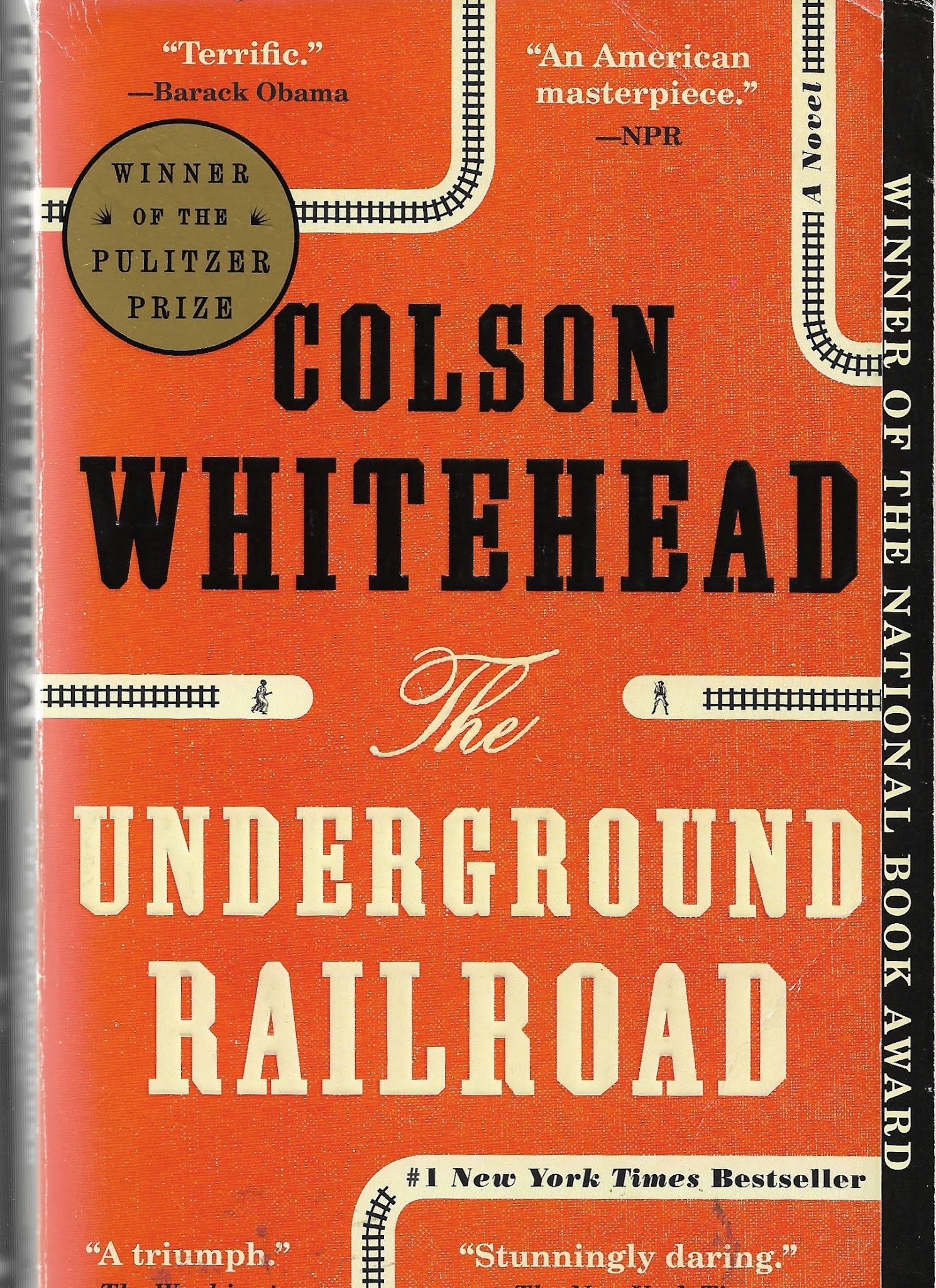
The Underground Railroad


Until my friend Chitrita gave me the book, I hadn’t heard the name of Colston Whitehead. Neither had I come across the string of words Underground Railroad. I will come to Colston Whitehead shortly, but before that, let me describe what “underground railroad” means in the context of American history.

Chattel Slaves in America: Men, women, and children kidnapped from Africa, ferried across the Atlantic chained to the hull in dark holds of ships, and sold at port-town markets to white American farmers. Besides suffering the ignominy of being treated as personal possession, they lived a life of such relentless hardship and pain that very few would live to become old.

Young women were also used as producers of more slaves; they were allotted to male slaves with strong physique, unless they produced mulatto babies as consequence of rape by owners or their overseers. Children, routinely taken away from mothers, were made to work in fields as soon as they were able to walk. Rape of and other sexual brutality on women were so common that we hardly see black Americans who are really black. When Alex Haley, the author of the 1976 novel Roots, The Saga of an American Family went to the heart of Africa in search of the hamlet from where one of his eighteenth-century forefathers, Kunta Kinte had been kidnapped, Haley was shocked to see the unblemished blackness of the African skin there.

For the slightest lapse, real or perceived, slaves were subjected to often sadistic torture by their white 

owners and their overseers. Lashing with a rope whip with nine notches – disingenuously named cat-o’-nine-tails – was the least punishment. The worst was reserved for people who had tried to run away and got caught. For a man, it could be cutting off his penis, shoving it into his mouth, stitching his lips and letting him die a slow death accompanied by even more torture, as his white owners and their guests watched the spectacle while having dinner in the open. For a woman runaway, it was so brutal that I find it difficult to type out.

Given the life they lived, many slaves fled their masters every year despite the humongous risks involved. On the other hand, there were professional “slave catchers”: white men who made a living out of tracking down and bringing back runaway slaves to their masters, sometimes from thousands of miles away. It was possible to recapture fugitive slaves even from the North American states where slavery was illegal, thanks to the Fugitive Slave Law of 1793 which granted immunity to slave catchers and compelled local officials to assist them. As the law required scant documentation to claim that a coloured person was a fugitive, slave catchers also kidnapped free Blacks, especially children, and sold them into slavery. The Wikipedia (accessed on 31 August 2020) says:

The law deprived people suspected of being slaves the right to defend themselves in court, making it difficult to prove free status. In a de facto bribe, judges were paid a higher fee ($10) for a decision that confirmed a suspect as an enslaved person than for one ruling that the suspect was free ($5).

However, the world is never devoid of people who would help their less fortunate brethren. Lots of people unknown to each other, both white Americans and free African Americans, collaborated to set up a network of safe houses and secret passages that were used to transport slaves from the southern states of America. Their destination was either British North America, most of which is presently Canada, or the northern American states which were more tolerant towards “negroes” in varying degrees, particularly certain cities like Philadelphia and New York, the latter being a “factory of anti-slavery sentiment.”

The “Underground Railroad” was neither a railroad, nor was it underground; it was a metaphorical name given to the network narrated above. The “railroad”, which did not have offices or official documents, began in the late 1700s and grew steadily until the American Civil War (1861-65). “One estimate suggests that by 1850, 100,000 enslaved people had escaped via the "Railroad".” [Wikipedia, accessed on 31 August 2020]

What if such a subterranean railroad actually existed in the mid-nineteenth century? Surely, it could only be in a fiction? In his Pulitzer-Prize-winning novel The Underground Railroad, African American writer Colston Whitehead (born 1969) takes his readers in a reverse journey from a metaphor to the imagined reality of an impossible railroad with the inviolable truth of bondage hanging as a constant backdrop.

It is the story of Cora, a third-generation slave born in a cotton farm in Georgia who was at the cusp of womanhood. Cora, who didn’t “have” a father like many other slaves, also had the misfortune as she had been abandoned by her feisty mother who ran away. Deep within, Cora nursed a desire to trace her mother and confront her, but she did not seriously consider the option of running away, which wasn’t much of an option in any case.

Yet, one moonlit night, she escapes because of a combination of circumstances and a newly recruited slave, Caesar who had befriended her. Caesar was like no coloured man Cora “had ever met,” because he could read and write, a fact which he concealed for his life, as having even an elementary education was a crime for a slave and it would attract severe punishment. Cora and Caesar don’t get into a physical relationship but continued as comrades in a shared quest for freedom.

They outrun and outwit their pursuers, manage to get the better of a vigilante group, and reach a shelter offered by a stooped grey-haired white Pennsylvanian, Mr. Fletcher. Fletcher, who abhors “slavery as an affront before God”, smuggles them out to the nearest railroad station, taking enormous risk – like every other person who collaborates with the railroad, irrespective of the colour of their skin.

After narrowly winning the first round against the southern white man who “was spat from the loin of the devil ….” Cora and Caesar climb down a steep staircase hidden beneath a trapdoor to a platform of the Underground Railroad. Their real journey begins.

Cora experiences “civilised” white people in South Carolina who do not brutalize her body, but are equally keen to own her mind, until the veneer of civilisation is flaked away one evening in a sudden burst violence that separates her from Caesar.

In North Carolina, after Cora sees miles of dead blacks hanging from trees, a kindly and extremely scared white man and his wife hide her and her chamber pot, on an airless platform in their attic, where Cora continues to nurse her dream of meeting mother. From a hole in the wall of her hideout made by an earlier fugitive, Cora watches a town square and a town without a black soul except when one is ferreted out of a safe haven like Cora’s, and is savagely done to death along with the white family that sheltered them, loudly cheered on by an ecstatic crowd. Cora stays there for months, until her luck runs out, and her hosts’.

Cora is back in shackles, this time, not metaphorically. She is chained to the floor of a wagon, perhaps closing a circle that began with her grandmother’s journey across the Atlantic.

As she heads towards a terrible future, her journey, wildly oscillating between despair and hope, traces the changing landscape and people of different southern states while America moves towards an inevitable bloodbath and Civil War.

Colson Whitehead’s novel, a story of enormous courage and resilience, resonates in our time as it opens our eyes to the depths people can climb down when hatred captures the mind of an entire community. Using a gruesome chapter of American and world history as the backdrop, Whitehead retells – in captivating prose – the story of tribalism and violence that are innate to humans.

The story makes us think if our species has a future.

Colson Whitehead / The Underground Railroad / First Anchor Books edition, 2018 / www.anchorbooks.com / Copyright © 2016 by Colson Whitehead

Monday, 31 August 2020 / 1453 words


Tuesday, 31 March 2020

The Corona Timeline, China, and WHO


[The information below has been collated from sources like the Wikipedia, BBC, Al Jazeera, ANI, and TOI]

1 December 2019: In the city of Wuhan in China’s Hubei province, symptoms of Severe Acute Respiratory Syndrome (SARS) were first noticed in a man.

6 December: His 53-year-old wife showed similar symptoms; hospitalized.

25 December: Two more Chinese in Wuhan quarantined after they showed similar symptoms. Later that week, hospitals in Wuhan saw an exponential increase of comparable cases.

In the same week, Dr. Li Wenliang, a 33-year old ophthalmologist, informed a group of doctors about a new virus.

31 December: The Wuhan Municipal Health Commission declared that there was no clear human to human transmission of the virus. China got in touch with the World Health Organisation (WHO). They reprimanded Dr. Li Wenliang for spreading rumours.

1 January 2020: Huanan Seafood Wholesale Market was shut down as several of those infected had reportedly worked at the market.

3 January 2020: Li Wenliang had to sign a declaration to the police that he had been spreading ‘fake information’. Same day, the Hubei Provincial Health Commission asked doctors not to test for new cases. Doctors had to destroy the existing samples. The Wuhan Municipal Health Commission reiterated its position on no human to human infection, indicating collaboration in suppression of truth.

8 January: China claimed they had identified the virus and reiterated no human to human transmission.

11 January: The Wuhan Municipality published a report stating that the infected people had a history of contact with the wet market. It reiterated the absence of human transmission.

12 January: Li Wenliang was admitted to the hospital following severe breathing problems and was put in intensive care.

13 January: Thailand reported the first case of coronavirus outside China: a Chinese woman who had a travelled to Wuhan.

14 January: WHO issued a statement saying that the preliminary investigation conducted by China showed no trace of human to human infection.

15 January: Japan reported the first case of coronavirus. The patient had no history of visiting any wet market of China. After this, the Wuhan Health Commission admitted the possibility of human transmission.

21 January: The United States reported its first confirmed case of a patient who had returned from China six days earlier.

22 January: The WHO conducts a field visit to China and concludes that human to human transmission is taking place in Wuhan.

31 January: Speaking at a news conference in Geneva, the Chief of the WHO described the virus as an "unprecedented outbreak". But he praised the "extraordinary measures" the Chinese had taken, and said there was “no reason TO LIMIT TRADE OR TRAVEL TO CHINA”. (BBC, emphasis added)

7 February: Li Wenliang passed away in hospital. Wikipedia says “A subsequent Chinese official inquiry exonerated him and the Communist Party of China formally offered a "solemn apology" to his family and revoked its admonishment of him.”

11 March: World Health Organisation (WHO) declared the Novel Coronavirus (COVID-19) as pandemic.

31 March: The virus has shut down the world, with 178 countries infected, more than 7,87,000 confirmed cases, and over 37,000 dead.

*

Five dates are crucial on the timeline:

1.       31 December, when China informed the WHO, but suppressed its severity.
2.       14 January, when the WHO downplayed the infectivity of the virus and misled the world community.
3.       22 January, when the WHO found out human to human transmission, but did nothing to warn the rest of the world.
4.       31 January, when the WHO refused to limit travel to and trade with China.
5.       11 March, when the WHO declared the disease as pandemic, A MONTH AND 20 DAYS LATER.

Will anyone be punished for this humongous criminal delay?

Photograph of Dr. Li Wenliang courtesy: https://en.wikipedia.org/w/index.php?curid=63046734

Friday, 12 October 2018

Let ME TOO speak out!


Over the last few days, women victims in India have been breaking down the Chinese Wall of shame and coming out against sexual assaults. We always knew there were sexual predators everywhere, including at workplaces, but the extent of the evil, now that it’s being spoken about, is more than horrifying.
It would be safe to think that for every woman who has chosen to go public with her protest, there are many more who haven’t. So far in India, women have come out only from two fields: the entertainment industry and the media. It would be laughable to think that men in other professions would be any better. So, what we see now is the proverbial tip of the iceberg.
It is deeply disturbing. I salute the women who have come out. They deserve immense respect because they must be going through intense pain while reliving in public what they have suffered in private till now.
I do hope the society will treat the victims with the respect and sensitivity they deserve. I do hope the criminals will be called out, and at least some big fish will go to jail. But it won’t be easy.
In November 2013, Tarun Tejpal, a high-profile editor, sexually assaulted a colleague, who happened to be his daughter’s friend, on a lift in a Goa hotel. When the details, including CCTV footage came out, it seemed to be an open and shut case. But after five years, the man is out on bail, and the victim would have been dragged to courts repeatedly, adding societal insult to her personal injury. And it doesn't happen in India alone.
Recently, US senators chose to ignore Dr Christine Blasey Ford’s moving testimony against a sexual predator who shows no sign of remorse. Promoting an accused predator to the Supreme Court of the United States after a sham of an investigation was a public indictment of a completely credible victim.
But I do hope ultimately, the Me-Too movement in India will lead to a more civilised workplace for women in a country where lots of men bow before clay images of women, but grope them and rape them when they are in flesh and blood.
Thursday, 11 October 2018

Friday, 11 November 2016

The end of the world? JK!!!


A pathological liar, a disgusting dunce 
Who knows nothing about
Things beyond the borders of his country,
A dishonest businessman, hasn’t paid taxes for ages,
And cheated his contractors time and again,
A shameless racist who reminds us 
Of the USA a hundred years ago,
A sexual predator who 
On TV measured women’s bodies on a scale of 10 to 1,
Who routinely walked into women’s changing room because 
The hapless youngsters were participating in a pageant owned by rogue,
An employer who regularly assaulted his women employees sexually. 
A first-class passenger who browbeat / bribed flight attendants to 
Upgrade an economy-class lady passenger to his next seat 
So that he could attempt to rape her.
And to cap it all,
Bragged about his exploits.
…
…
…
Has just been elected the president of the US of A.

Because the so-called disenfranchised white Americans,
Including a majority of white women,
Many of whom university graduates
Voted for him. 

SHAME ON AMERICA.
SHAME EVEN MORE ON THE AMERICAN WOMEN. 

It happened because
Once upon a time
A white immigrant’s children 
Could enjoy a lavish life-style 
By a lot of real hard work 
Without any real education.
A school drop-out 
Could drive a truck 
And own a bungalow with a garden and two cars,
Could have six children, 
And send all of them to college if they qualified. 

IT WAS WONDERFUL EXCEPT 
THEY BELIEVED IT WAS THEIR BIRTHRIGHT UNTIL ETERNITY,
WHICH IT WASN’T. 

Because, there was a time when they had to open their doors 
For qualified non-white immigrants who could 
Fill in the gaps 
That drivers and tradesmen with enviable life-style couldn’t.
The next generation of these new imports became 
University profs, and some even Nobel Laureates.
And the uneducated well-off just couldn’t compete.

But more importantly,
BECAUSE IN THE MEAN WHILE,
THE WORLD HAD CHANGED.
It refused to be bullied.

And brutal American businessmen 
Could no longer run banana farms in Columbia,
Or drug cartels in Venezuela.
Local thugs took their place.

Because the new tyrants in the Middle East 
Refused American Corporations to
Take their liquid gold for a pittance.

Because it was no longer possible 
To set up a cyanide plant in the middle of an Indian city,
Ignore safety rules completely,
Murder 30,000 people,
Maim many more,
And get away scot-free – no criminal charges at all –
And wash their sins
By paying a holy $750 for every human life they extinguished.

Because in the mean while
The world had become a lot more competitive.
Chinese workers produced computers,
Bangladeshi women stitched shirts,
And Indian engineers wrote codes
At a fraction of what it would cost in the USA.

But the stupid white Americans,
Who hate people who can read and “think”,
And don’t read the superb American newspapers
Produced by brilliant white, black, yellow, and brown Americans, ….
World affairs have never been their strong point,
Staunch anti-communists who’ve painted their country “red”
Had no clue, didn’t know, couldn’t believe that

AMERICA CAN NEVER BE “GREAT” AGAIN.
And chose to elect the stupidest of their lot
Who happened to be a crook too,
and had promised them the moon.

SO WHAT?
The world has survived many dirty wielders of power.
It will survive Donald Trump.
Because for every dirty Donald Trump
There is a decent Barack Obama
Because for every Hitler,
There has been a Gandhi.
For every Mussolini, a Nelson Mandela,
For every McCarthy, a Martin Luther King.

So Cheers! 
This is not the end of the world.

[With thanks to Moumita for opening my eyes to some of the facts.]


Bangalore / 10 November 2016

Sunday, 6 November 2016

Stephen Hawking on Donald Trump


I have been trying to follow the US Presidential elections, which is due in two days, because the outcome will have a bearing not only on the USA, but on the entire world. Donald Trump’s victory – which is still possible – will be a great fillip to the forces of lack of reason, illiteracy, and bigotry. A lot of countries in the world including the land of “Bharat Mata” are being ruled by such people, let’s not have any illusion about that. On a day when 1700 schools in Delhi have been shut down because children cannot breathe in the toxic Delhi air any more, our wonderful Urban Development minister, who looks and talks like a mawali, is busy defending shutting down NDTV’s Hindi Channel for a day. What sense of priorities! (Don’t know who a mawali is? You must, if you are an Indian. Please google for the word.)

The American election has been one of the nastiest political battles which would put even our Mamtas, Mulayams, and Mayavatis to shame. In a way, it’s good. It has removed the façade of the so-called “liberal democracy” of the West. When the times are bad and the chips are down, most preachers show their teeth and claws.

Another aspect, which has been generally overlooked by the commentators on both either of the Atlantic, is that this election has been singularly devoid of humour. Lack of humour is a bad thing, it indicates something is seriously wrong somewhere. But no problem, the world is fine!

Stephen Hawking, said to be the greatest theoretical physicist of our time, did the job. Please read this hilarious New Yorker report (31 May 2016).

LONDON … Stephen Hawking angered supporters of Donald J. Trump on Monday by responding to a question about the billionaire with a baffling array of long words.

Speaking to a television interviewer in London, Hawking called Trump “a demagogue who seems to appeal to the lowest common denominator,” a statement that many Trump supporters believed was intentionally designed to confuse them.

Moments after Hawking made the remark, Google reported a sharp increase in searches for the terms “demagogue,” “denominator,” and “Stephen Hawking.”

“For a so-called genius, this was an epic fail,” Trump’s campaign manager, Corey Lewandowski, said. “If Professor Hawking wants to do some damage, maybe he should try talking in English next time.”

Later in the day, Hawking attempted to clarify his remark about the presumptive Republican Presidential nominee, telling a reporter, “Trump bad man. Real bad man.”

In case you have missed the point, the USA is a land of native speakers of English. Political illiterates of the world unite, you have nothing to lose but your ignorance.


Bengaluru / 6 November 2016

Sunday, 23 October 2016

The deepest pit and Michelle Obama


As we moved from the innocence of childhood to the confusion of youth, our conscience was partly shaped by one of the most asymmetric conflicts of modern history – the war in Vietnam. Children were Napalmed, small-built, skinny peasants were facing the might of the most powerful nation on the earth for no reason at all, and defeating them as much on the battlefield as in the theatre of global opinion. There were other theatres too … Salvador Allende murdered … countless cruel dictators propped up by the CIA at the cost of their peoples. Paraphrasing Salman Rushdie, it is impossible for a non-American to love the United States of America.

That impression is still valid, particularly after Iraq, but I got to see another, totally different face of the “Ugly American” when I stayed there for several months, and isn’t it an impressive face?

I was amazed by their efficiency, total absence of corruption in day-to-day transactions, their immense capacity for hard work, their free press, and most importantly, their respect for manual labour. A plumber in America often has a more comfortable lifestyle than a university teacher, and certainly less insecurity about his career. So, if I have to sum up the USA in one sentence: it’s a land of contradictions.

And contradiction is seen in every aspect of the American life. Its universities produce Nobel laureates in science at metronomic regularity, yet a fair number of Americans are arithmetically challenged. Americans dominate business in far corners of the world, but an average American is often astonishingly uninformed about anything beyond their borders. I recall, once, when I told a shop assistant that the Long Island potato chips she sold were excellent, she asked me, ‘Do you make potato chips in India?’ And it was not an isolated instance.

And as the world keenly followed the presidential elections in the US in 2016, it was amazing to see the deep pits to which American politics has sunk. Bernie Sanders, the only untainted person in the race, was too much of a leftist to be tolerated by the American establishment. He had to lose out. But the two major parties elected such terrible candidates with questionable pasts … it's almost incredible.

And yet, as the race progressed, one of them, Donald Trump turned out to be an utterly disgusting specimen of humans and as a consequence, Hillary Clinton has turned out to be the messiah who could save America and possibly, the world. Her numerous sins like the questionable sources of funds for the Clinton Foundation and her snugly warm relationship with the thugs in Wall Street have been happily forgotten. Oh God! Anyone but Donald Trump and his goons!

But it is America. A counterpoint to the murky politics had to emerge, sooner or later. And it appeared in the shape of a few speeches by Michelle Obama. In particular, her speech in Phoenix on 20 October 23, 2016 was spellbinding, but more importantly, it was stirring defence of values in public life. It was a political speech in support of the lesser evil in the election, but it went much beyond, it would have touched a chord in every human being who believes in gender equality in particular and decency in general.

If you haven’t heard the speech, please do. The following link also gives the full transcript of the speech:

Postscript:

Annie Perkins writes in the Guardian: “When she speaks, Michelle Obama doesn’t stop being the wife of the president, but she transcends it. She becomes the personification of the best of her country. … Who in Britain can make that nonpartisan appeal to ordinary human decency? Last night she spoke for everyone who thinks politics can be better than this.”

Replace the word Britain with India, or any other country, the statement would be valid, wouldn’t it?

(650 words)

Bangalore / 23 October 2016


Friday, 3 June 2016

Donald Trump and …

Duriing the run-up to the US presidential election scheduled later this year, Donald Trump has astounded the world with his unconcealed hatred towards Muslims, Latino, Chicano, and other immigrants in the USA, American Democrats, and also the Third World (read the poor of the world) in general. Such filthy, always-unsubstantiated verbal aggression against anyone who is not perceived to be on his side is shocking even by the standards of the US Republicans. In the New York Times, Charles M Blow writes on 2 June 2016:
“Donald Trump, a man who tosses the truth around with the callous disdain of a spoiled child with a toy he has outgrown, has spent much of his campaign calling the media dishonest ….
 “He seems to view any unflattering, or otherwise critical, coverage as an attack. His rhetoric suggests that in his mind, adulation is the only honesty. 
“But there is a strand of these comments and behavior that heralds something more dangerous than an ideological animosity toward the press. Trump keeps signaling that if he had his [way], he would silence dissent altogether.”
As I was reading the article, I couldn’t but think back to the just concluded elections in West Bengal. The similarities are chilling!

Replace Donald Trump with Mamata Banerjee, he with she, his with her, and the text above fits in perfectly with the WB elections in April / May 2016. Particularly, the expression “adulation is the only honesty” seems to have been written with Ms MB in mind.

Donald Trump will most probably lose the elections, although his opponent, Hillary Clinton, is carrying her own baggage. However, Mamata Banerjee has won a thumping victory. Let’s see where she takes West Bengal in the next five years.

And please pray, if you are a believer.


Bengaluru / 3 June 2016

Tuesday, 29 March 2016

Can we learn from this conservative politician?


John McCain, the Republican Senator from Arizona, famously lost to Barack Obama in the US presidential elections in 2008. I happened to be in the US during the elections and followed the debates as closely as I could. 

The Grand Old Party that McCain belongs to had just produced one of the worst Presidents in the American history, George Bush, besides the Iraq war and the financial melt-down that brought the entire world to the brink of a disaster. Like most human beings who were not insane, I detested the American Conservatives, I still do. 

But despite my inhibition about the party and the values that the GOP stands for, I couldn't but admire McCain as an individual. He had a simple, practical, down-to-earth approach to the issues and was infinitely graceful in defeat. And his background helped. 

Fighter pilot John McCain's plane was shot down in Vietnam. McCain, who survived the crash with severe injuries, was tortured even when he had been injured. He spent a long time in Vietnamese jails, and although he could have bought his freedom early thanks to his connections -- his father was, if I am not mistaken, a navy admiral and consequently a part of the ruling elite of the US. But John McCain refused to tread that path, didn't wish to leave his comrades behind in jail by exploiting the accident of his birth. 

So I was not surprised when I read this in the New York Times. It is a touching obituary for an ordinary American, who had been -- trust me -- a communist! 

Do we Indians, tormented by an at-times-violent tolerance-intolerance debate, have anything to learn from John McCain?

If you wish to read the article, please click on this link.

[Photo - Courtesy New York Times]

Kolkata / 29 March 2016

Friday, 2 July 2010

Printed letters - A postscript

For most children today, printed letters have been replaced by moving images on a TV screen, at least in our country. Very few fortunate children develop the habit of reading. After reading my remark “When I gave a book to a nephew … I saw a shadow of disappointment cross his face”, a reader, Sujith has commented that it is not so in at least one first world country, the USA. He writes:
… let me tell you how different (it is) here in NY. Kids are groomed to develop the taste for reading. My daughter is in kindergarten and it’s amazing how much emphasis is given to reading. Every week her teacher sends a book home and we have to read with her. Also parents are encouraged to buy books from a company and the company donates a book to the class library. Whenever I travel, I see Americans always reading something, on the flight or train or at airports. Now I know where it comes from.
I am obliged to Sujith for sharing this piece of information with me. My wife and I were in the US when my grandson was born at Yale University Hospital. Immediately after his birth, several counsellors visited his parents and urged them to read to the infant right from day 1. In fact, the reading had begun even before that. Researchers have found that babies in womb too respond to reading and would-be-parents are encouraged to read aloud for the benefit of the baby even before s/he is born.  I also found their system of public libraries amazing and wrote about it in my post titled Libraries in the US.

It was the time when Barrack Obama was trying to become the president. One of the main planks of Obama’s future plans was to make American children better students, so that they could compete with Indians and Chinese. Here in India, as opportunities are limited, some children study hard because they know they have no other choice. But I am yet to recall an election speech by an Indian politician in which education is mentioned even peripherally.

Coming back to the children who grow up with the TV as their main companion, I am sure their world is a lot more colourful and things happen at a much faster pace there. We used to gather information slowly, by reading. These days, children directly interact with the world beyond their immediate surroundings with two senses, eyes and ears. Also, they get to receive a lot more information than we did. As a result, they are vastly more well-informed than we were. And smarter.

But they miss out on one aspect. They “see” stories, mainly cartoons. We didn’t see things directly. For us, eyes were just a tool to decode the enormous wealth of information hidden in printed letters. We actually saw with our mind’s eyes. Whether it was a journey to the moon or the centre of the earth, every child in my childhood travelled to their personal imaginary destinations. Each young reader had their own perception about of Fagin’s brutality or Dr. Livesey’s gentlemanliness.

Many children of the twenty-first century, though rich in information, do not have the luxury of imagination. The see the way TV producers want them to see things.

Saturday, 29 August 2009

Libraries in the US


One of the many things that make the United States of America a civilized country is their system of public libraries. I must add quickly that I am aware of the deep fallacy inherent in this statement. Experience shows that reading does not always make us better or more civilized human beings. The worst rogues in this world are necessarily well-informed, and possibly well-read. Therefore, the impact of libraries on their user populations is questionable. Be that as it may, one can quote Borges: “I do not know if education can save us, but I do not know of anything better.”

Trumbull in the state of Connecticut, is a small town. This place has a post office, a few gas stations and banks, and a handful of shops. As you walk along empty pavements, you see nothing but speeding cars, beautiful bungalows with gardens, and a green backdrop that will turn red in a month's time. Only two buses ply on the Main Street – on which our house is – and their drivers work from 9 to 5.


But this small, undistinguished town has two ubiquitous symbols of modern America: a shopping mall, where you can buy everything except a few necessities of life like aircraft and ships, and a quaint library ensconced in a lovely garden. From outside, the library looks like any other ordinary building, but as you walk in, you see that it has a beautifully designed interior with polished pine wood furniture and hushed shades on walls. Behind the reception desk, the big hall splits into two levels. There are designated areas for the teens, the elderly (books in large print), and numerous computers with Internet access, besides a separate children's library in an adjacent hall. There are large racks of CDs, DVDs, and audio books, but the best part of the library is its stacks where one can browse through books for hours. Since leaving my university in Santiniketan, I forgot what an open-stack library looked like, and the esoteric pleasure of being surrounded by thousands of books .... If you can't find the book you want, the library will get it from whichever library in the state has it, and telephone you to inform that your book has arrived.

At any time of the day, you find many people in the library, reading, or working on the computers. You see very elderly people in mechanized wheelchairs, working people, housewives, students, and small kids with parents. Everyone is engrossed in their work, and you feel that a lot of people in this country read, a fact that you would already have noticed on local trains and at sea beaches. (There are full page advertisements for new books, mostly fiction, in newspapers almost every week.) My mind drifts to the stories I have read back home about the average American's ignorance and lack of general knowledge and I wonder why no one writes about the people I see in the library here. That Americans are generally ignorant is as true as Indians being generally poor. According to the Time Magazine (24/08/09), "They (Americans) ranked global warming last in a national survey of 20 top priorities". But isn't wallowing in another people's weaknesses a cheap ego trip, just like some tourists from richer countries photographing beggars and garbage dumps in India?

Soon after coming to the USA, I noticed that the only thing cheaper here than in India is peeing. This is a country of pay-and-use highways and free toilets, which are usually spotlessly clean. I have recently come to know that the second thing that is free here is the public library. Water is an expensive commodity here, (it costs nearly as much as orange juice), but you pay nothing for membership of a bibliothèque. You don't even have to be a tax payer or a citizen. All they need for membership is a proof that you are a resident of the area.

And how many of them do they have? A visit to the website of the public libraries revealed that every city town or village in the US has one or more libraries. From the website, I discovered that there are not one, but two in Trumbull. The state capital, Hartford, a city of 1,24,062 people, has 11 public libraries. One of them is expectedly named after Mark Twain, the most illustrious son of the city.

The recession that began in 2008 has hit the libraries. There has been some closures and threats of much more closures. But ironically, the recession has also increased library usage as many families cannot afford new books, films, or Internet connection at home. A newspaper has described the public libraries as recession sanctuaries. Fortunately, at this difficult time, the USA has a man in charge whose main resource is knowledge and intelligence, as opposed to birth and bank balance of many of his predecessors. A policy of the federal government is "refurbishing the nation's classrooms and labs and libraries so our kids can compete". Grants to libraries is a part of the economic recovery package.

Fifteen years ago, India had neither shopping malls, nor libraries for the masses. Today, we have the former, many of them, and nobody is bothered about the latter. We can only imagine the impact that would be if we copied the public library system of the USA along with, if not instead of, their shopping malls!


[I was thinking about writing on the topic for some time. The immediate trigger was a post by my young friend Tanmoy on his blog about libraries in New Zealand. Thank you, Tanmoy.]

Tuesday, 18 August 2009

The Great Plains, the Grand Canyon


6.10 AM: We have come to the circular parking lot behind our Las Vegas hotel, to be picked up for a trip to the Grand Canyon. Somewhat happy and proud to have reached the spot five minutes early, we find that everyone else is already here.

6.20 AM: We are at the office of the Grand Canyon Tour Company, behind a long queue, which Americans call line. I pay cash at a counter. The counter clerk counts and puts the money in his till and says, 'Have a great day!' Doesn't give me a receipt. During my first trip to the US, I used to be surprised by the average American's lack of enthusiasm for paper work. A lot of work is done here on trust.

8.00 AM: The coach is moving at over 120 kilometers per hour. Outside is a vast plain, uninterrupted by trees or human habitation. The horizon is made up of flat low hills. The landscape is full of the azure sky and cirrus clouds. The Great Plains of America, read in books, now in front of my eyes.


8.30 AM: The land outside looks even more arid. We see some hillocks with beautiful bungalows on their slopes. Our driver and guide, Ron announces that some Hollywood celebrities have houses there: 'That pink bungalow belongs to Barbara Streisand … the one there on your right now … is Brad Pitt and Angelina Jolie's … and that house with three palm trees belongs to my girl friend, Nicole Kidman ….'

Ron communicates exceedingly well, and like many Americans, takes the business of cracking jokes seriously. As we approach the Hoover Dam, he announces: 'Ladies and Gentlemen, we are going to stop at a checkpoint now. Please remain seated. A police officer will come on board and check for things like guns and explosives. His name is Jack. You can greet him. You can say, “Good morning, Jack!” or “How are you, Jack” or “Have a good day Jack!” … but please, ... please don't say “Hi Jack!”'

9.00 AM: We have just crossed the Hoover Dam. The land surface has turned sandy, scattered with low bushes. The soil seems too dry to support big trees. The only tree that we see has short, stout trunks and cactus like foliage. Our guide informs these are Joshua trees. (Spelt with a capital J possibly in deference to the original Joshua.) We are in the heart of the Mojave (MO'HAAVI) Desert that stretches across the states of California, Arizona, Nevada and Utah. Ron has deep knowledge of the plants and animals of the desert and talks eloquently about the snakes, lizards, birds, and plants that live here. For example, he tells us exactly how long we would survive if we were bitten by different snakes of the desert.

On a serious note, I have rarely come across someone who can talk with equal or more authority on the natural environment around them. Ron has a particularly soft corner for the California condor, which has been saved from extinction in the recent past.

He has been driving tourist coaches here for the past five years. In the evening, he reads about the desert on the Net. Earlier, he had driven trailer trucks for eight years and had logged a million miles of accident-free driving. A reassuring piece of information.

12.30 PM: During the lunch break, I ask Ron if everyone in his line takes the trouble of looking up the Internet to read about the flora and fauna of the Mojave Desert. He smiles, embarrassed, but with a touch of pride.

1.00 PM: After a most satisfying lunch at an eatery named the Grand Depot Café, we are on the final leg of our journey to the Canyon. We drive along the Route 66, a highway that has a place in American history. We pass a small township that looks straight out of a Western. We see Clint Eastwood sitting on a horse, with a stetson hanging low on his eyes.

1.30 PM: The journey was so enjoyable that we almost forgot about the destination. But we are thrilled to hear the announcement that we are about to reach the Grand Canyon. The coach drops us at a place called the Mather Point on the South Rim of the Canyon. We start walking along what is known as the Kaibab Trail.

1.35 PM: We are looking at a relief map below, the only difference is that it is not man-made and the the scale is 1:1. About 65 million years ago, this plateau was pushed up by 1,500 to 3,000 metres (five to ten thousand feet) because of a massive upheaval within the bosom of Mother Earth. The strata we see were formed below sea level. The river continued to flow, undaunted. The waters of the mighty river together with wind and rain erosion created a most intricate pattern of layered earth. The Grand Canyon is said to be an open book of geology. But ordinary mortals like me can only be overwhelmed by its enormous beauty.


The sun is high above us, on the other side of the gorge. The earth and the rocks are of a wide variety of colours and textures. With the sun going behind and coming out of clouds, and the angle of the incident sunlight changing almost continuously, the landscape alters every minute. Actually, we are watching a movie projected from another world.

The River Colorado is much below. We don't know how deep the chasm is, but it could be two kilometres or more. We cannot see the river most of the time. Only at one point, it shows up. It looks like a shining ribbon of silver. We can only imagine the great force and turbulence of the water down below.

We also come across a hiker's and mule trail. If you aren't fit enough to trek down, but wish to raft on the river below, you can hire a mule ride for going to the bottom of the valley. But there is no chance that we can. The mule ride is booked a year in advance. This is not the finest picture on the subject, but it will give you some idea.


A visit to the Grand Canyon is a humbling experience. Here, you come face to face with the enormity of Nature. It offers you a feast for the eyes, and contemplation for the mind.


Trumbull, Connecticut
17 August 2009